
Key Words: Silicon Wafer Dicing PCB Depaneling Glass Cutting
Home > News > Industry News
【Description】:
Discover how 3D five-axis laser cutting technology solves manufacturing challenges for helmet shells. Explore precision contour trimming and normal-axis hole drilling.
Helmet manufacturing – whether for cycling, motorcycling, industrial safety, or military use – represents one of the most demanding and representative applications for 3D five‑axis laser cutting technology. The outer shell of any modern helmet is a complex, double‑curved 3D surface that must be precisely trimmed and perforated. Traditional cutting methods struggle with these geometries, but 3D five‑axis laser cutting has become the indispensable solution.
Helmet shells are made from a variety of materials:
PC/ABS or polycarbonate – injection‑moulded, used in mid‑range helmets.
Carbon fibre composites – compression‑moulded, for high‑end racing and military helmets.
Fibreglass composites – a cost‑effective alternative.
Regardless of the material, every helmet shell is a 3D curved surface – it is not a flat or developable shape but has compound curvature in all directions. This geometry dictates that all cutting operations must be performed in three‑dimensional space, not on a flat plane.
Before the widespread adoption of 5‑axis laser cutting, helmet shells were trimmed and pierced using:
| Traditional Method | Key Drawbacks |
|---|---|
| CNC routing / milling | Rapid tool wear (especially on composites); burr formation requiring secondary sanding; tool interference on curved surfaces; limited access to complex contours. |
| Die‑cutting / stamping | High tooling cost per design; unable to handle deep 3D contours; rough edges that still require manual finishing. |
| Manual grinding / sanding | Extremely slow and inconsistent; impossible for high‑volume production; health hazards from dust. |
The common failing of all these methods is that they cannot produce a finished cut edge in a single operation – they invariably require secondary finishing steps such as deburring, sanding, or hand trimming.
After injection or compression moulding, the helmet shell has excess material – sprue remnants, flash, or process allowance – that must be removed to achieve the final designed contour. The shell’s edge runs along a complex 3D curve.
How five‑axis laser cutting excels:
Beam perpendicularity at every point:
On a curved shell, the surface slope changes continuously. A 5‑axis system uses its two rotary axes to keep the laser beam exactly perpendicular to the local surface at every point along the trim path. This ensures:
A square, non‑tapered cut face.
Uniform kerf width.
A smooth edge that needs no filing or sanding.
Non‑contact, stress‑free processing:
The laser cuts by melting and vaporising material, with no mechanical force. This eliminates any risk of distortion or delamination – a critical benefit for thin composite shells where mechanical cutting can cause layer separation.
Single‑pass, full‑contour cutting:
The 5‑axis system follows the entire closed‑loop 3D contour of the shell edge in one continuous motion, without stopping or re‑clamping. One setup, one cut, one finished edge.
Helmet shells require numerous openings distributed across their curved surface:
| Feature Type | Purpose | Cutting Requirement on Curved Surface |
|---|---|---|
| Ventilation holes | Airflow for comfort | Typically 5–15 mm diameter, located on the crown and sides; hole axes must be normal to the local surface |
| Visor / shield mounting slots | Attachment for face shields | Non‑circular contours on the forehead area; must match the surface curvature accurately |
| Speaker / communication system cutouts | Installation of Bluetooth or intercom | Located near the ears, often on the inner side; require shaped recesses or through‑holes |
| Rear mounting openings | For adjustment knobs or lighting | Positioned on the back‑of‑head curved region |
Five‑axis advantages for these features:
Normal‑axis drilling: For each hole, the beam can be oriented independently so that the hole axis is perpendicular to the local surface (or at any specified angle). This ensures that mounted components fit flush against the shell.
Complex profile cutting: For non‑circular openings (e.g., visor mounting cutouts), the system follows a 3D spatial curve, ensuring the shape matches the surface perfectly.
Consistent inner/outer dimensions: The laser produces nearly identical kerf widths on both the outer and inner surfaces, which is crucial for subsequent bonding or assembly.
This is the most transformative impact of 3D five‑axis laser cutting on helmet manufacturing.
Traditional process chain:
Moulding → rough cutting of excess → CNC trimming → manual sanding/deburring → inspection and rework → next process
Five‑axis laser process chain:
Moulding → one‑step 3D laser cutting (trim + holes) → directly to next process
Eliminated steps:
Manual sanding and deburring
Rework after finishing
Secondary clamping and setup
Chanxan offers a proven solution for helmet shell processing with its 3D Five‑Axis Laser Cutting Machine.
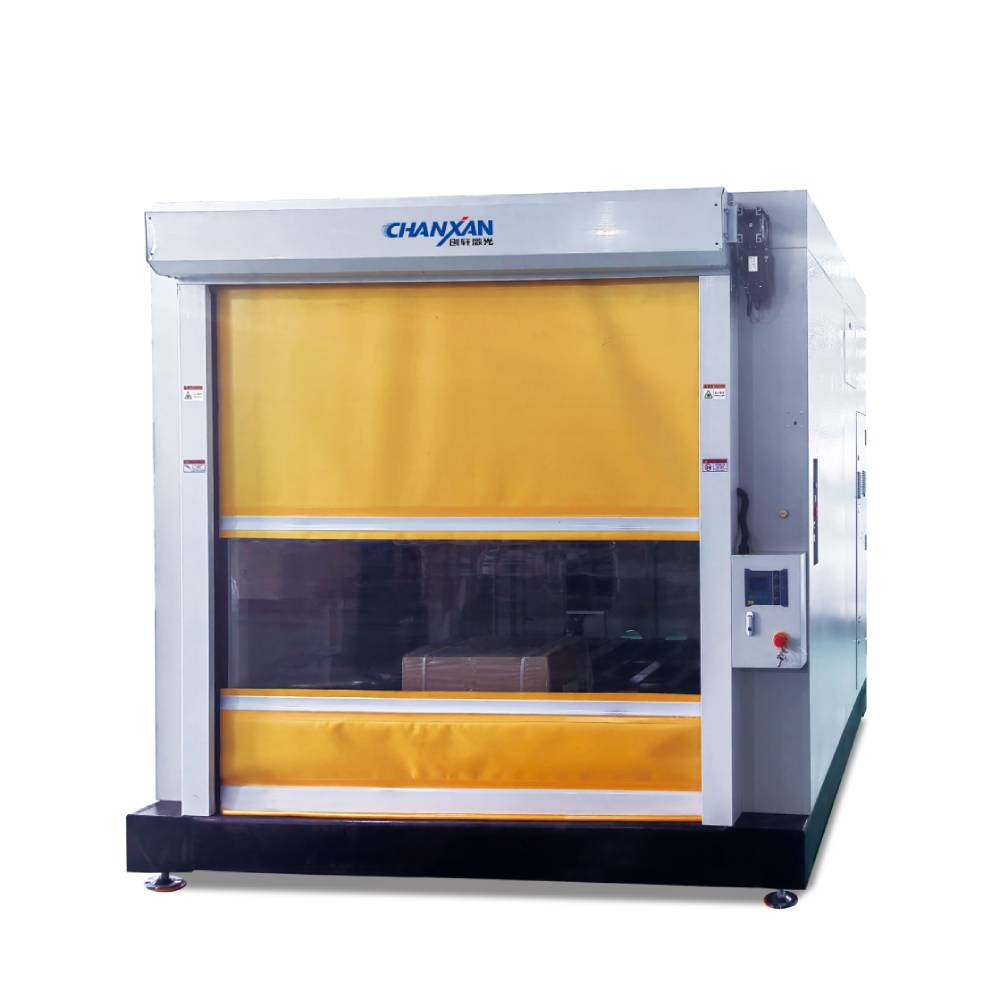
| Chanxan Feature | Specific Value for Helmet Processing |
|---|---|
| True 5‑axis linkage | Enables precise contour trimming and normal‑axis hole drilling on the complex curved surface, ensuring square edges and accurate feature placement. |
| DMP Teaching System | Operators simply guide the cutting head along the shell edge to “teach” the path – no CAM programming required. For model changes, just re‑teach the new contour. Perfect for helmet manufacturers with frequent design updates or multiple models. |
| Non‑contact processing | Eliminates mechanical stress, preventing delamination of composites and distortion of thin plastic shells. |
| Dual laser source options | CO₂ laser for PC/ABS and polycarbonate; fibre laser for carbon fibre and fibreglass composites – one machine covers all common helmet materials. |
Contact our technical experts today for custom cutting solutions and a free instant quote.
Contact Us to Get a Quote| Free solution
Previous: How 3D Five-Axis Laser Cutting Machines Process Complex Plastic and Automotive Parts
Next: 5 Axis Laser Cutting vs 3 Axis Laser Cutting: What Is the Difference?